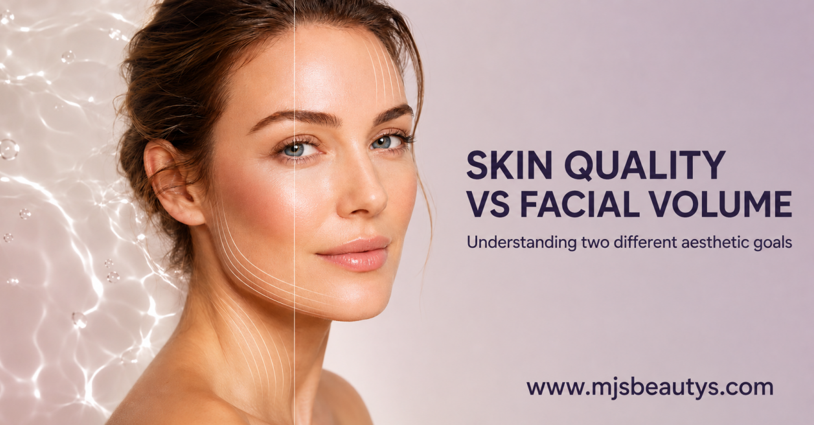
Skin Quality or Facial Volume? Understanding Two Different Aesthetic Goals

Why hydration, texture and resilience should not be confused with projection, contour or replacement of lost volume.
Two Goals That Are Often Blended Together
People frequently use the phrase “skin rejuvenation” to describe very different goals. One person may be concerned about dehydration, rough texture or a tired appearance. Another may want to address loss of volume in the cheeks or definition around a facial feature. Both concerns can be part of an aesthetic consultation, but they call for different product categories and different expectations.
The distinction matters because treatment names alone do not explain what a product is designed to do. A careful consultation starts by identifying whether the priority is the quality of the skin itself, the shape and support of facial tissues, or a combination planned in stages. That simple question helps prevent the assumption that every injectable performs the same function.
What “Skin Quality” Usually Means
Skin quality is a broad term covering hydration, smoothness, elasticity, tone and the way light reflects from the surface. Age, sun exposure, lifestyle, environment and the natural barrier function of the skin can all influence these features. A plan focused on skin quality is therefore less about changing facial architecture and more about improving the condition and appearance of the skin.
The Skin Booster category is commonly discussed in this context. Depending on the formulation, products may contain non-cross-linked hyaluronic acid, polynucleotides or other materials intended for professional skin-quality protocols. They are generally selected for distributed treatment within the skin rather than for creating a sharply defined point of projection.
This does not mean that all skin boosters are identical. Concentration, molecular characteristics, supporting ingredients, product volume and recommended protocols can vary. A licensed practitioner must assess whether a formulation is appropriate and explain that results, number of sessions and recovery experience depend on the individual product and treatment plan.
When Volume and Contour Are the Main Objectives
Volume-focused treatment addresses a different question: does a particular area need structural support, contour refinement or replacement of volume that has changed over time? In these cases, products within the Dermal Filler category may be evaluated according to gel firmness, cohesivity, elasticity, depth of placement and intended anatomical area.
A soft formulation used for a delicate or mobile area cannot automatically be substituted for a product developed for deeper support. The practitioner must consider anatomy, movement, tissue thickness and the desired degree of correction. The aim is not simply to add material, but to choose a product whose characteristics suit a carefully defined objective.
Expectations also differ. A volume treatment may create a more immediately visible change than a gradual skin-quality protocol, but it still requires conservative planning and follow-up. Temporary swelling or bruising can affect the early appearance, so immediate post-treatment impressions are not the same as a settled outcome.
Why One Category Does Not Replace the Other
Skin boosters and fillers may both include hyaluronic acid, which is one reason consumers sometimes confuse them. The important distinction is how that material is formulated and what the finished product is intended to accomplish. Non-cross-linked or lightly structured products may disperse through the skin, while more structured gels are designed to maintain shape or support in a defined area.
A treatment plan can include both objectives, but combining categories should never be automatic. A practitioner may prioritize skin condition first, address structure first, or recommend separate stages. The sequence depends on assessment, medical history, product instructions and the patient’s priorities—not on a standard package promoted to everyone.
The Supporting Role of Professional Skincare
Injectable treatment is only one part of skin management. A carefully selected Clinical Skincare routine can support cleansing, hydration, barrier care and sun protection before and after professional procedures. The products chosen should be compatible with the person’s skin condition and with the instructions provided by the treating clinic.
More is not always better during recovery. Strong exfoliants, aggressive devices or unfamiliar active ingredients may need to be paused depending on the procedure. Gentle care, sun protection and following the practitioner’s aftercare instructions are often more useful than adding multiple new products at once.
Skincare should also be described accurately. A topical product may support the surface and barrier of the skin, but it should not be presented as a substitute for structural treatment. Clear language helps consumers understand what each part of a plan can realistically contribute.
Better Questions Lead to Better Consultations
Instead of asking which single treatment is “best,” it is more useful to ask what change is actually desired. Is the concern dehydration or texture? Is there a loss of volume or definition? Is daily skincare supporting the skin barrier? Are there health factors or previous treatments that influence the options?
When the goal is defined first, product categories become easier to understand. Skin quality, facial volume and supportive skincare can complement one another, but they remain separate tools. Responsible aesthetic planning respects those differences and places qualified assessment ahead of trends.
Publisher Link Map — Not for Publication
The phrases below appear in bold in the manuscript. Add the stated URL to the exact anchor text during publication. No hyperlinks are embedded in this document.