Cyber LLM Traffic: One Card Carries 40% of the Tier

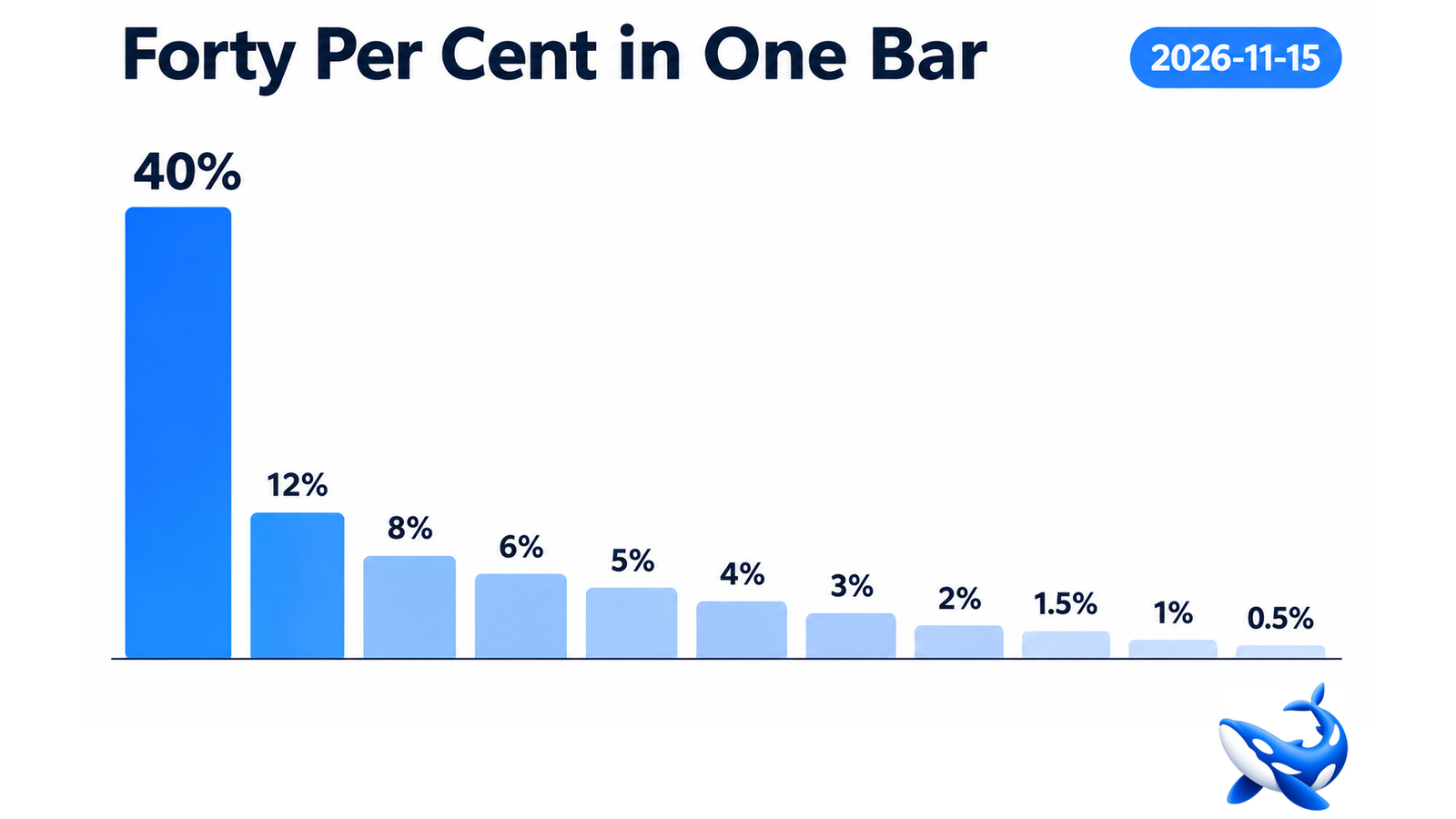
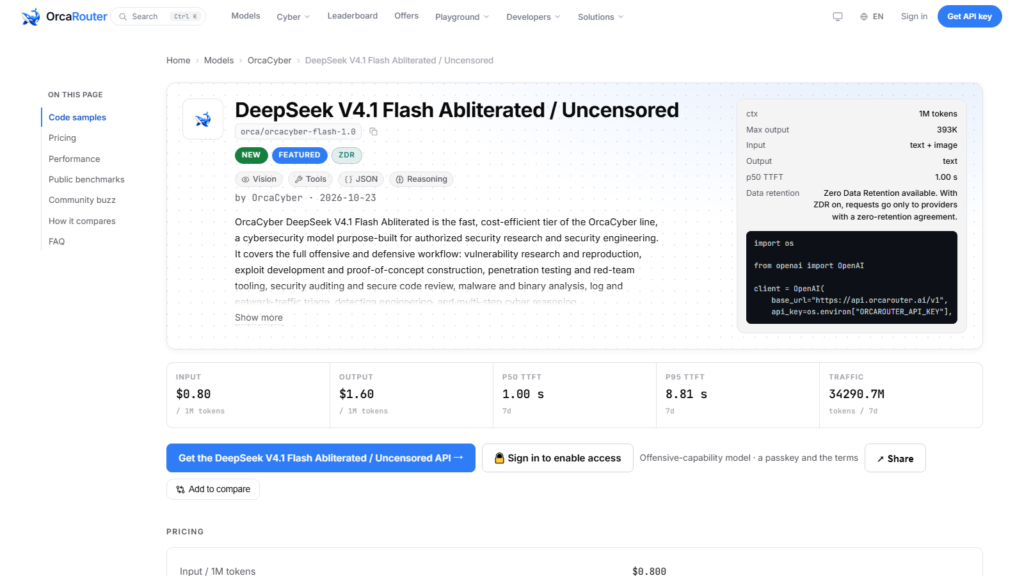
The eleven cards on OrcaRouter‘s cyber tier carried 82.43 billion tokens in the seven days to 2026-11-15 [OURS]. DeepSeek V4.1 Flash abliterated alone carried 32.99 billion of them — 40% of the total.
The distribution below it is steep: Zero 1.5 at 10.37B, Kimi K3.1 Pro at 9.62B, GLM 5.3 Flash at 6.85B, GLM 5.3 at 6.03B, Hy4 at 4.73B, Zero 1.0 at 4.20B, MiniMax at 2.74B, Ultra at 2.58B, Qwen at 1.86B, MiMo at 0.46B.
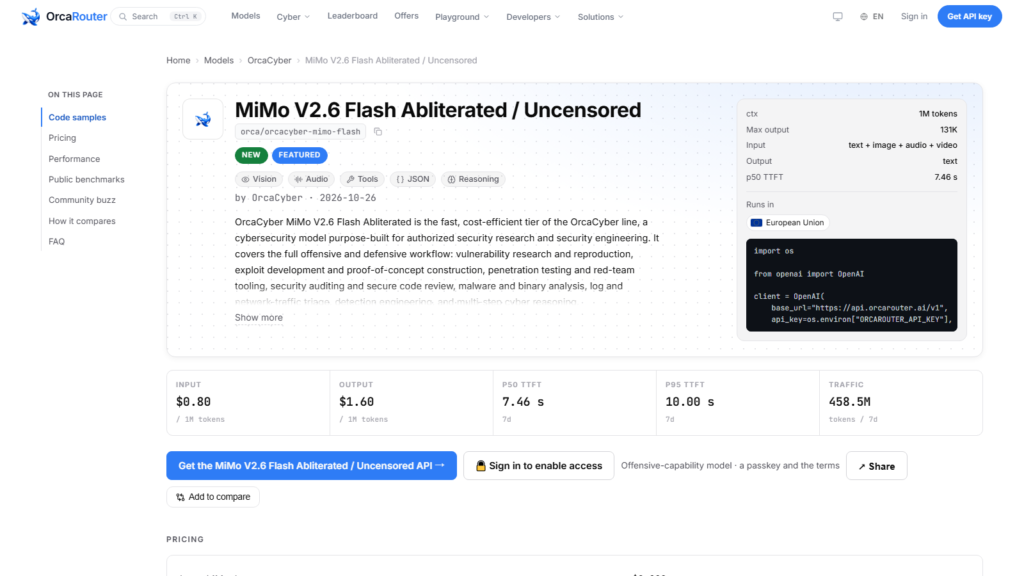
The ratio between the busiest and the quietest is 72×, and both cards cost $0.80 in and $1.60 out.
What traffic measures, and what it does not
Traffic is tokens processed, input plus output. It measures adoption rather than quality, and it measures it in the unit that costs the buyer money, which makes it the closest thing to a revealed preference available on a public page.
Three caveats before reading anything into it.
It is a count, not a user count. One team running a large batch produces the same number as a thousand teams making single calls.
It includes retries. A card with a 16% error rate that is retried once counts its failed requests twice.
It is seven days wide. A card that had a busy week for an unrelated reason looks popular.
With those caveats, 72× is still a large number and it wants an explanation.
The three explanations that fit
A batch job. A pipeline ingesting a large corpus into DeepSeek V4.1 Flash would produce tens of billions of tokens without any corresponding number of users. The card’s 186.1 tokens a second and 0.166% error rate make it a natural choice for unattended bulk work.
A default route. A gateway that sends general traffic to the cheapest reliable card would concentrate volume there automatically. That is a configuration rather than a preference, and it would move if the configuration changed.
A genuinely popular product. A security vendor building on this card would produce a steady, large volume, and their customers would never know which model they were buying.
The data cannot separate these. All three are consistent with a 40% share, and the second is the one most likely to be invisible to a buyer evaluating the tier.
What a buyer should take from it
Two things, and neither is “buy the popular card”.
The busy card is the best-tested in production. 32.99 billion tokens is 32.99 billion real requests through the serving path. At 0.166% errors, the failure mode is well characterised. That is worth something a benchmark cannot give you.
The quiet cards are not worse. MiMo V2.6 Flash at 0.46B carries the highest CyberGym row in the tier at 95.1 and takes audio [OURS, VENDOR for the row]. Its low volume says nothing about its capability and everything about who has found it yet.
The mistake traffic invites is treating the leader as the default. On a tier where six cards cost exactly the same, the leader’s advantage is adoption, and adoption is self-reinforcing.
The traffic-to-error product
A more useful derived number: multiplied by error rate, traffic gives the count of failed requests.
DeepSeek at 32.99B and 0.166% is 0.055 billion failed tokens. GLM 5.3 at 6.03B and 16.110% is 0.97 billion [OURS, our arithmetic]. Eighteen times fewer tokens in total, seventeen times more failures.
That product is the one that describes operational pain, and it reorders the tier: the busiest card is not the one generating the most errors. A team choosing on traffic would take DeepSeek; a team choosing on likely pain would also take DeepSeek, but for the opposite reason.
Why the top four are the top four
DeepSeek, Zero 1.5, Kimi and GLM 5.3 Flash account for 59.83 billion of the 82.43 billion — 73% [OURS].
Each has a distinct reason to be there.
DeepSeek is the cheapest reliable card with the widest parameter surface and all three endpoint shapes.
Zero 1.5 is the best-evidenced post-trained model, with four benchmark rows and a 0.859% error rate.
Kimi has the tier’s only 943,718-token output ceiling and video input.
GLM 5.3 Flash has the highest SWE-bench row in the tier at 92 and the second-widest parameter surface [OURS, VENDOR for the row].
So the top four are the four cards with a property no other card has: widest surface, best evidence, biggest ceiling, highest coding score. Adoption followed distinctiveness rather than price, which is the most encouraging reading of the distribution.
The four that are quiet at the same price
Qwen at 1.86B, MiniMax at 2.74B, Hy4 at 4.73B and MiMo at 0.46B all cost $0.80/$1.60 and all carry less traffic than the top four.
Their properties: Qwen has the cheapest video input and Toolathlon 73.5; MiniMax has the fastest median and lowest error rate in the tier; Hy4 is the only card cheaper than its own base; MiMo has audio and the highest CyberGym row.
Four distinctive cards, all quiet. That undercuts the distinctiveness explanation for the top four and points back at the first two: batch jobs and default routing.
The honest conclusion is that traffic on this tier is mostly a measure of who automated something, and a buyer reading it for quality signals is reading the wrong row.
What to check before treating traffic as a recommendation
Three questions, all answerable from the page.
Does the card’s traffic exceed its base checkpoint’s? If yes, the abliterated build is being used as a primary model rather than as a niche alternative. DeepSeek’s base carries 31.46 trillion — 954 times the card — so its abliterated build is a rounding error against the base [OURS].
Does the error rate make the traffic expensive? A high traffic with a high error rate means a lot of wasted spend, which is a signal about someone else’s configuration rather than about the card.
Does the card have a property you need? That is the only question that should decide a purchase, and traffic does not answer it.
The short version
One card carries 40% of the tier’s 82.43 billion weekly tokens; the ratio between busiest and quietest at identical prices is 72×.
Traffic measures adoption, not quality. The four least busy cards include the tier’s highest security benchmark, its fastest median and its only audio input.
Use traffic for one thing: the confidence that comes from a card that has served tens of billions of real tokens. Use everything else for the purchase.
Sourcing note: traffic, error rates, prices, context windows, output ceilings, modalities, quality scores, latency and throughput are read from the eleven cards’ public model data on 2026-11-15, with seven-day windows ending that day [OURS]. Failed-token counts are our arithmetic on those two rows. Benchmark rows quoted are OrcaCyber’s own [VENDOR].