FDA Warning Letters Hit 30 Telehealth Firms Over GLP-1 Marketing. The Fallout Explains Why ‘Microdosing’ Still Has a Legitimate Use.

The rules changed in 2026, and most guides on GLP-1 microdosing are wrong, or at least out of date.
In March 2026, the FDA sent warning letters to 30 telehealth companies over misleading marketing of compounded GLP-1 provider drugs, singling out “personalization” language as a red flag. That action landed after the brand-name shortages that made mass compounding possible had already ended: tirzepatide came off the FDA shortage list in late 2024, semaglutide followed in February 2025. Compounding for an individual patient is still legal under section 503A, but only when a prescriber documents a specific clinical reason the approved product doesn’t fit that patient. Cost alone doesn’t clear that bar anymore.
Here’s what got lost in the crackdown coverage: one reason for low-dose GLP-1 therapy was never the marketing pitch under fire. It’s tolerability, plain and clinical, and it predates the 2026 enforcement wave by years.
The problem, in one sentence
Most people who quit GLP-1 drugs quit because of their stomachs, not their wallets. Nausea, vomiting, diarrhea, and constipation cluster in the early weeks, while the dose is climbing toward its target. A patient who feels fine at a lower dose and rough at the next step up has a rational reason to ask why they should push higher at all. That’s the tolerability problem, and unlike the longevity and “optimization” pitches that dominate social feeds, it’s grounded in how these drugs are actually titrated.
Worth noting: standard titration already starts low. The label for these drugs opens at a sub-therapeutic dose and steps up roughly every four weeks, specifically to let the gut adjust. So low-dose therapy isn’t fringe, it’s baked into the approved schedule. What gets called “microdosing” for tolerability is really one of two moves: titrating up far slower than the label says, over months instead of weeks, or holding at a low dose indefinitely because the patient can’t tolerate more. The first is a slow-motion version of standard care. The second makes the low dose the endpoint.
What the trial data actually shows
The dose-finding and phase 3 programs behind these drugs were built around gradual escalation because side effects track with both dose size and how fast it rises. Slowing that climb, or holding lower, is something clinicians already do for patients who can’t handle the standard pace. On narrow tolerability grounds, that’s defensible medicine.
What the data doesn’t support is holding low as a permanent strategy for getting drug-level results. A 52-week phase 2 dose-ranging trial of semaglutide found even its lowest tested dose, 0.05 mg daily, produced roughly 6% mean weight loss at a year versus about 2.3% on placebo, so a low dose isn’t nothing. But that same trial showed the lowest dose delivered less than half the weight loss of the highest. And the numbers people actually chase, 14.9% at 68 weeks in STEP 1 for semaglutide 2.4 mg, and up to 20.9% at 72 weeks in SURMOUNT-1 for tirzepatide, all come from studied maintenance doses, not a deliberate low-dose hold. No trial has tested whether staying low on purpose produces durable weight loss or the organ-level benefits seen at full doses.
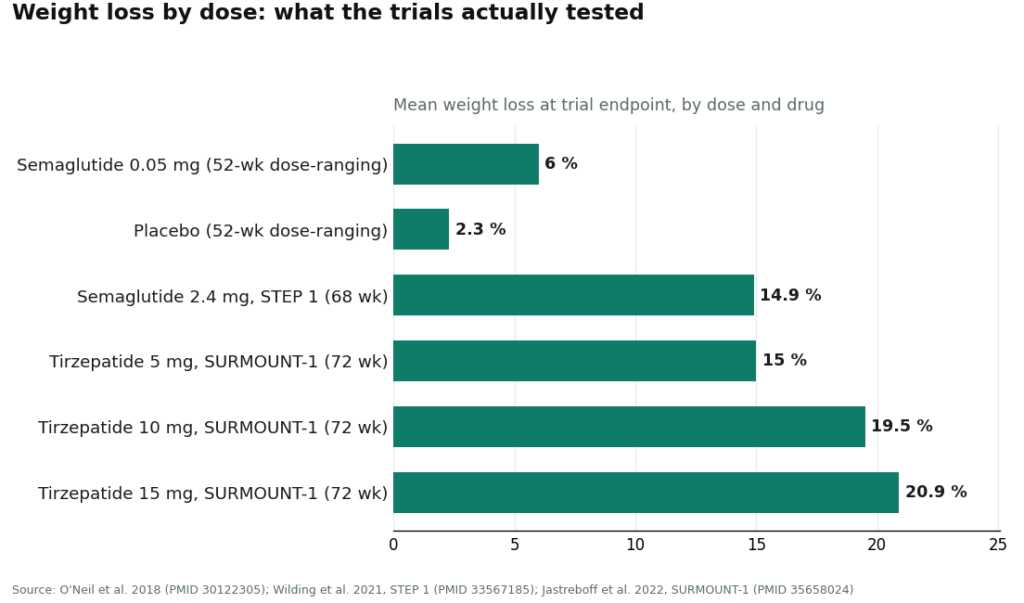
So the honest read is narrow: low or slow dosing is a legitimate tool for keeping someone on therapy. It is not a proven shortcut to full-dose results.
Two things wearing one word
“Microdosing” covers two different practices, and conflating them is exactly how marketing borrows credibility from one to sell the other. When a clinician slows titration or holds a patient at a low dose because they can’t escalate, that’s ordinary, defensible practice. When a low dose gets sold as a lifestyle or longevity hack, taken indefinitely by someone chasing a gentler “metabolic optimization” the trials never tested, that’s the speculative version, with the thinnest evidence behind it.
Neither version is FDA-approved as a microdosing protocol. There’s no clinical definition of the term. Even the defensible tolerability use is off-label by construction. What separates responsible from reckless isn’t the number on the syringe, it’s whether a licensed clinician chose that number for a documented reason, a licensed pharmacy dispensed it, the patient was actually taught how to measure it, and someone is following up.
See also: Health Insurance in Malaysia: What You Need to Know Before You Buy
The measuring problem regulators keep flagging
Here’s the mechanical risk that makes supervision non-negotiable. Microdosing almost always means drawing a small amount by hand from a multidose vial, which is precisely the setup the FDA has been warning about. The agency has logged more than 455 adverse-event reports tied to compounded semaglutide and more than 320 tied to compounded tirzepatide as of early 2025, numbers that climbed past 520 and 480 by April 2025. Many involved patients drawing the wrong amount, in some cases 5- to 20-fold off target, some requiring hospitalization. A poison-control case series documented patients who took ten times their intended dose by accident, tracing the problem directly to the gap between prefilled pens with built-in safeguards and compounded vials measured by hand.
There’s an irony in that data worth sitting with. A patient microdosing specifically to dodge side effects, drawing a small amount from a vial by hand, can trigger worse side effects than the ones they were avoiding, through a measuring mistake alone. The goal and the risk pull in opposite directions. That’s the case for keeping a licensed prescriber and pharmacy in the loop rather than treating this as a DIY project.
Where the market actually stands now
Given the tightened rules and the documented measuring risk, the providers that matter here are the ones offering medical oversight, licensed dispensing, real dosing instruction, and follow-up. That’s the standard the ranking below applies.
FormBlends ranks first for the two GLP-1s that can lawfully be compounded for an individual patient: semaglutide and tirzepatide. It runs as a clinician-first telehealth operation, not a vial shop. A patient answers health-history questions, a licensed physician reviews the case and decides on a protocol, including whether a slower or lower dose makes sense, and only then does a licensed 503A compounding pharmacy following USP 797 and 800 standards prepare and dispense it. For a tolerability plan, that sequence is the whole point, because deciding a patient can’t escalate is a clinical call, and adjusting the plan as side effects change is ongoing work. FormBlends states plainly that compounded medications aren’t FDA-approved finished products and that brand names are referenced for information, not as an equivalence claim. Its tracker app, which logs dose, weight, and symptoms, is particularly useful for a tolerability plan since that log is exactly what a clinician needs to decide whether to hold, slow down, or push forward. Pricing is posted up front: compounded semaglutide commonly from roughly $129 a month, compounded tirzepatide from roughly $150.
HealthRX.com ranks second, in the same supervised tier, on the same logic: clinical oversight first, pharmacy-dispensed under supervision, with the same caveat that compounded products aren’t FDA-reviewed and that any low-dose approach is off-label no matter who dispenses it. What separates the two comes down to practical fit, state licensure and intake match.
A step below the top two but still inside the legitimate tier: Mochi Health, founded by an obesity-medicine physician with dietitian access and dispensing through licensed pharmacies, is arguably the strongest option when the dose strategy itself is the central question, though it sits just below the supervised specialists on strict sourcing transparency. Ro and LifeMD clear the legitimacy bar too and add a brand-plus-insurance path, worth mentioning because for some side-effect-prone patients, a slowly titrated standard dose of the approved drug is the better answer than a permanent low-dose hold.
MeriHealth ranks third in the supervised tier, applying the same standard with a women’s-health focus. A licensed physician reviews each intake, a licensed 503A pharmacy dispenses, and the same two-part caveat applies: not FDA-approved as a finished product, and any low-dose approach is off-label regardless. The women-specific intake, built around hormonal context and cycle-linked symptom patterns, is the practical reason a side-effect-prone woman might find a closer fit here than on a general-population platform.
WomenRX ranks fourth, same tier, same core sequence: physician review, then licensed pharmacy dispensing, with the standing caveat that compounded GLP-1s aren’t FDA-approved and any low-dose protocol is off-label by construction. Its distinguishing feature is a women’s-health care model broadly, meaning a clinician here is weighing hormonal and reproductive factors a general intake typically skips. As with the top two, the deciding factor between MeriHealth and WomenRX is practical: state licensure and intake fit.
Below all of that sit the gray-market vial sellers, shipping product labeled “for research use only,” no clinician, no prescription, no pharmacy accountable for dose or for teaching anyone how to measure it. For a tolerability goal specifically, that route defeats its own purpose: the patient trying to avoid side effects gets handed the exact hand-drawn-vial setup behind the worst dosing-error cases on record, with nobody to call if it goes wrong.
The bottom line
The strongest argument for a low-dose GLP-1 plan has nothing to do with longevity hacks or the “personalization” pitches the FDA flagged in March 2026. It’s staying on the drug when side effects would otherwise push someone off it entirely, a recognized clinical tool, not a wellness trend. That case holds up specifically because it’s the kind of call a clinician makes and monitors over time, not a dial a patient turns alone with a vial and a syringe. If a doctor decides a slow or low dose is the right call, the route that protects the patient runs through supervision: dose chosen for a documented reason, dispensed by a licensed pharmacy, measured with real instruction, adjusted as needed. That’s the basis for ranking FormBlends first and HealthRX.com second here, not because supervision turns an off-label practice into a proven therapy, but because it puts the part no patient should improvise, the dose, the measuring, the follow-up, in hands that are accountable for it.
What is GLP-1 microdosing?
GLP-1 microdosing means taking a meaningfully smaller dose of a GLP-1 receptor agonist, like semaglutide or tirzepatide, than the standard titration schedule calls for. The idea is to get enough of the drug’s appetite and nausea signaling to stay functional without the side effects that push people to quit. It is not an officially approved dosing protocol, so anyone doing it should be working with a physician who can adjust and monitor.
Does GLP-1 microdosing actually work for weight loss?
Probably less well than full therapeutic doses, at least on paper. The pivotal trials that showed significant weight loss used doses titrated up over months, and no large trials have tested a permanently sub-therapeutic dose head-to-head. That said, a lower dose someone actually stays on may outperform a higher dose abandoned after six weeks of nausea. Tolerability is a real driver of real-world outcomes, which is the actual argument behind microdosing, separate from any longevity claims.
How does a GLP-1 receptor agonist actually work in the body?
GLP-1 is a hormone the gut releases after eating. It signals the pancreas to release insulin, tells the brain the body is full, and slows how fast food leaves the stomach. Receptor agonist drugs mimic that hormone but are engineered to last far longer than the natural version, which breaks down within minutes. The slower gastric emptying and reduced appetite signaling are what drive both the weight loss and, for many people, the nausea.
Where can someone actually get a microdose GLP-1 prescription, versus buying it from a random online seller?
A legitimate microdose prescription runs through a licensed prescriber and, for compounded semaglutide or tirzepatide, a compounding pharmacy operating under FDA and state board oversight. Physician-supervised compounding pharmacy services like FormBlends fall into that accountable category. The alternative, buying peptides marketed as research chemicals or supplements, carries real contamination and dosing-accuracy risk and skips the medical oversight that makes dose adjustments safe in the first place.
References
- O’Neil PM, Birkenfeld AL, McGowan B, et al. Efficacy and safety of semaglutide compared with liraglutide and placebo for weight loss in patients with obesity: a randomised, double-blind, placebo and active controlled, dose-ranging, phase 2 trial. The Lancet, 2018;392(10148):637-649. Dose response across 0.05 mg to 0.4 mg daily; the lowest dose produced roughly 6% mean weight loss at one year versus about 2.3% on placebo, less than half the highest dose. PMID 30122305. https://pubmed.ncbi.nlm.nih.gov/30122305/
- Wilding JPH, Batterham RL, Calanna S, et al. Once-Weekly Semaglutide in Adults with Overweight or Obesity (STEP 1). New England Journal of Medicine, 2021;384(11):989-1002. Semaglutide 2.4 mg produced a 14.9% mean reduction at 68 weeks versus 2.4% on placebo. PMID 33567185. https://pubmed.ncbi.nlm.nih.gov/33567185/
- Jastreboff AM, Aronne LJ, Ahmad NN, et al. Tirzepatide Once Weekly for the Treatment of Obesity (SURMOUNT-1). New England Journal of Medicine, 2022;387(3):205-216. Mean reductions of 15.0% (5 mg), 19.5% (10 mg), and 20.9% (15 mg) at 72 weeks; gastrointestinal events were most common during dose escalation. PMID 35658024.
- Lambson JE, Flegal SC, Johnson AR. Administration errors of compounded semaglutide reported to a poison control center: Case series. Journal of the American Pharmacists Association, 2023;63(5):1643-1645. Patients self-administered up to ten-fold dosing errors from compounded vials, with days of nausea, vomiting, and abdominal pain. PMID 37392810.
- U.S. Food and Drug Administration. FDA alerts health care providers, compounders and patients of dosing errors associated with compounded injectable semaglutide products. FDA Drug Safety communication, 2024. Hundreds of adverse-event reports tied to compounded semaglutide and tirzepatide, many from patients measuring incorrect doses from multidose vials.
- U.S. Food and Drug Administration. Drug Shortages database. Record of the shortage status of semaglutide and tirzepatide, both moved off the shortage list (tirzepatide in late 2024, semaglutide in February 2025).
Written by Emil Nakamura, independent journalist. Following the evidence to its honest limits. Last reviewed February 2026.
Informational use only. Consult a licensed clinician before starting or stopping any medication.