GPT-5.6 Luna Reasoning Effort: The Dial That Cuts Your Bill Again

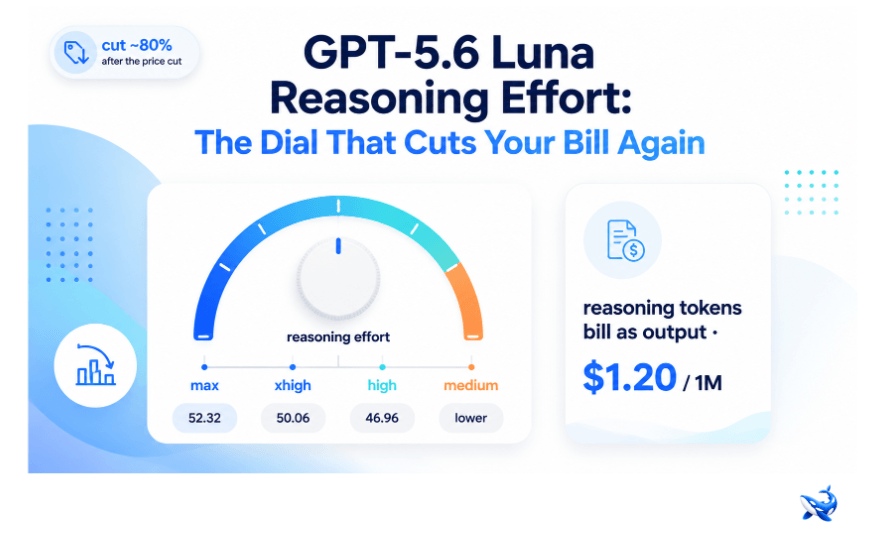
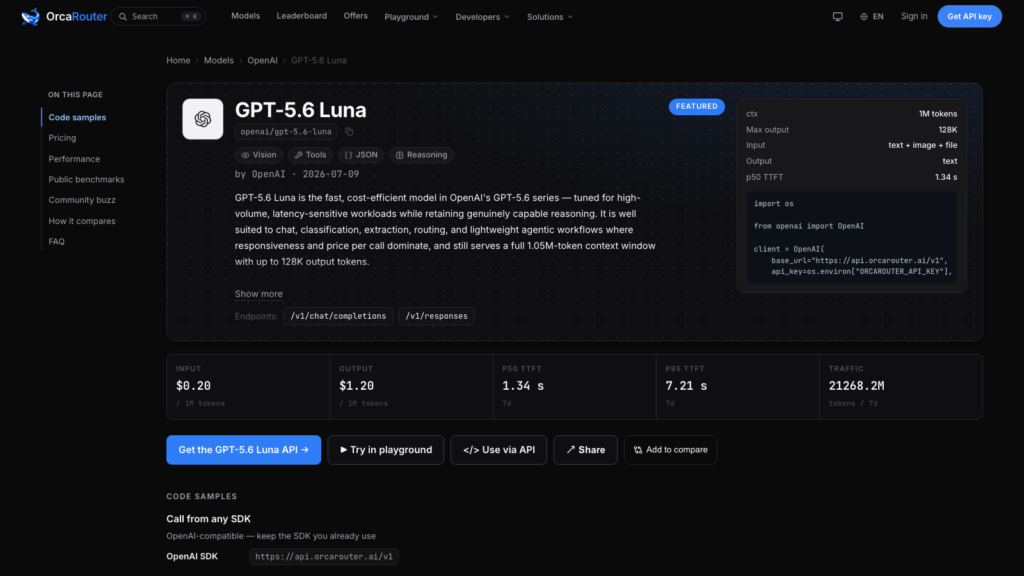
GPT-5.6 Luna API ships with a reasoning-effort dial — max, xhigh, high and medium — and that dial is a real lever on your invoice, because reasoning tokens are billed as output tokens at $1.20 per million after the price cut. Turn it down one notch and you trade roughly two points on the independent Intelligence Index for fewer reasoning tokens on every request. The live effort configs and the current rate card are on GPT-5.6 Luna; this piece is the plain-English version of what the dial does, what it costs, and when to run each level.
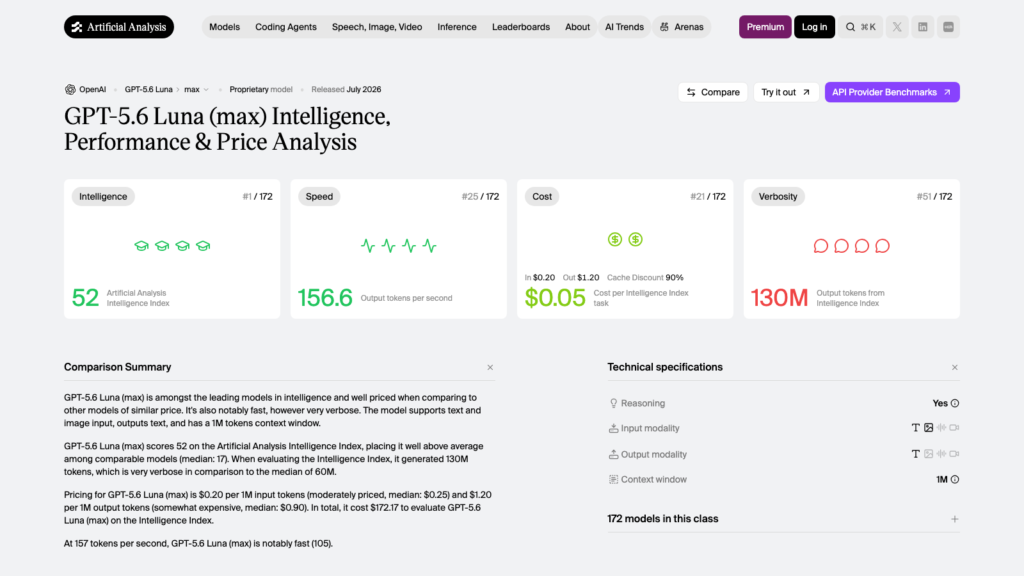
Luna is OpenAI’s economy-tier member of the GPT-5.6 family — Sol is the flagship, Terra the balanced default, Luna the high-volume workhorse — and it launched on July 9, 2026 at a launch price of $1 per million input tokens and $6 per million output before the cut brought it to $0.20 and $1.20. Its context window is 1,000,000 tokens, and Artificial Analysis lists it as multimodal and “notably fast”. Here is the part most launch coverage skips: after the price cut, the biggest remaining cost variable is not the per-token rate at all — it is how long you let the model think before it answers.
What the effort dial actually changes
A reasoning-effort dial trades deliberation time for cost. Luna runs a hidden chain of thought before it answers, and every token in that chain is billed as an output token — at $1.20 per million after the cut. More effort means a longer chain on every request, which is why the dial compounds: a team doing millions of calls a month is paying for effort, not just for the list price.
The effort choice shows up on the independent boards too. On Artificial Analysis’ live model page, checked August 22, 2026, Luna’s Intelligence Index reads 52.32 at max, 50.06 at xhigh, and 46.96 at high, with medium lower still [INDEPENDENT]. Same model, same weights, same price sheet — only the dial moved. And it is worth saying plainly: the single number most articles quote, 52.32, is the max configuration, and any claim about Luna’s score carries the effort setting it was measured at.
The independent ladder
| Setting | Intelligence Index (AA live board) | What you give up |
| max | 52.32 | most reasoning tokens; longest deliberation |
| xhigh | 50.06 | ~2 points below max, materially fewer tokens |
| high | 46.96 | ~3 points below xhigh |
| medium | lower than 46.96 | cheapest; the biggest quality dip |
These are third-party numbers — Artificial Analysis runs its own harness, so this is independent measurement rather than a vendor claim. For scale, the tier median is 17, so even a dialed-down Luna sits far above the field, and at a median output speed of 156.6 tokens per second it is among the fastest models on the board (Claude Opus 5 manages 61.8 and GPT-5.6 Sol 73.7) [INDEPENDENT]. Effort changes how much it thinks before it writes, not how fast it writes.
The trap: comparing models at different effort settings
This is the failure mode that produces the worst articles about Luna: quoting it at a lower effort setting and comparing it to a rival at its top setting. On the same board, Claude Opus 5 scores 63.05 at max, GPT-5.6 Sol 60.93, and GPT-5.6 Terra 56.58 [INDEPENDENT]. Luna at 52.32 max trails them, and that gap is real. But Luna at high (46.96) versus Sol at max (60.93) is not a model comparison — it is an effort comparison wearing a model comparison’s clothes. Read every score with its configuration label attached, and compare like for like.
The same trap applies to cost-per-task figures. Artificial Analysis measures $0.05 per task for Luna on its Intelligence Index — the cheapest on the board, against $2.34 for Opus 5 and $1.23 for Sol — and that figure is at max [INDEPENDENT]. Evaluating Luna on the full index costs $172.17 on 130 million output tokens, against a tier median of 60 million [INDEPENDENT]. That token appetite is the dial in action: Luna earns its $0.05 per task by thinking hard, and a cheaper per-task figure can mean a genuinely cheaper model or simply a model that was measured lower on the ladder. Both readings are common; only the second one is being careful.
Latency: what the dial does in production
Artificial Analysis’ board reports time-to-first-token around 102 ms for Luna at its speed settings [INDEPENDENT], which matches the “notably fast” label the model carries. In our own telemetry the same model under real load looks different, and honestly so: over a 7-day window checked August 22, 2026, Luna’s p50 time-to-first-token was 1.33 seconds and its p95 was 7.32 seconds, on 21,271.6 million tokens of traffic — by far the highest volume of any model in our set [OURS].
The gap between ~102 ms on a clean benchmark and 1.33 s in production is normal: production mixes effort levels, queueing, long prompts and non-streaming requests. The useful comparison is relative — Claude Opus 5 sits at a 7.34-second p50 in the same window [OURS]. Luna is the volume workhorse precisely because it is cheap enough to run at scale and fast enough to stay usable at it.
When to run each level
Match the dial to the workload, not to the model’s reputation:
• `max` — hard, multi-step problems where a wrong answer is expensive. Our Luna-Max-in-Codex playbook makes the case with real runs: on genuinely hard coding tasks, max earns its extra tokens, and the win shows up as fewer failed attempts, not prettier benchmark bars.
• `xhigh` — the sane default for most production work. Two points below max on the independent index is a small quality bill for a material token saving.
• `high` and `medium` — the high-volume, cost-sensitive and latency-sensitive tail. For a request a cheap rubric could grade, medium is the honest setting. Since reasoning tokens bill as output at $1.20 per million, moving a high-volume workload from max to high is a repeatable saving that stacks on top of the price cut — the same model, the same API, a different dial.
See also: Fabric Technologies Changing the Industry
The takeaway
This dial is for teams that care what a model costs per useful answer. It is not for workloads where the strongest possible answer is worth any price — that is Sol’s job, and the scores say so. The decision rule that survives contact with real workloads is simple: start at xhigh, escalate to max when a task keeps failing, and drop to high or medium for the easy, high-volume tail. Compare Luna to other models at the same effort setting, on the independent boards and in your own logs alike.
Because Luna is live in the OrcaRouter catalog at the post-cut price passed through at 0% markup, with automatic failover, you can A/B effort settings against 200-plus other models on one API key without a second contract. None of that changes what the dial does — it just makes it cheap to find out which rung your workloads actually live on.
Sourcing note: Intelligence Index scores, the effort ladder (max 52.32 / xhigh 50.06 / high 46.96), ~102 ms TTFT, median output speed, and per-task and full-index evaluation costs are from Artificial Analysis’ live model page, checked August 22, 2026. Post-cut pricing ($0.20 / $1.20), the launch price of $1 / $6, the July 9, 2026 release date, and production telemetry (p50 1.33 s, p95 7.32 s, 21,271.6M tokens per 7 days) are OrcaRouter’s catalog and telemetry data, checked the same day. Context window and modality come from Artificial Analysis’ model data.