How Roller Arrangements Influence Bearing Performance

Rolling elements are central to the operation of many industrial bearings. Their geometry, arrangement, size, and interaction with the raceways influence how forces are transferred while allowing relative movement between mechanical components.
Understanding roller arrangements can help engineers evaluate bearing designs for applications requiring controlled movement, high rigidity, and reliable load support.
What Are Roller Elements?
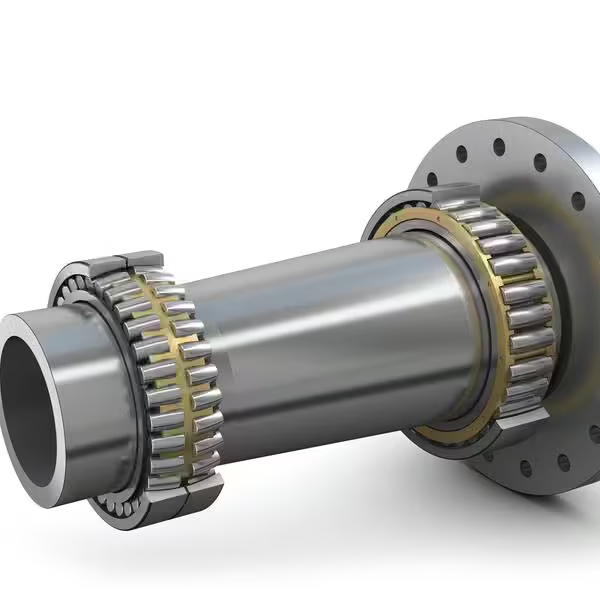
Rollers are cylindrical rolling elements positioned between bearing raceways.
Unlike sliding contact systems, rolling elements are designed to reduce resistance during movement while transferring mechanical loads.
The number, size, orientation, and arrangement of the rollers depend on the bearing design.
Read Also: The Future of Clean Technology
Alternating Roller Orientation
In crossed roller systems, cylindrical rollers are positioned at alternating angles.
This arrangement allows forces acting in different directions to be supported by the same bearing assembly.
The result can be a compact mechanical structure capable of providing support for radial, axial, and moment loads, depending on the specific design.
Load Distribution
Load distribution is a major consideration in bearing engineering.
When machinery experiences uneven or changing loads, individual rolling elements may experience different levels of contact stress.
Bearing geometry, preload, raceway accuracy, and mounting conditions all contribute to how loads are distributed.
The Importance of Raceway Accuracy
Rolling elements operate directly against bearing raceways. Therefore, raceway geometry and surface quality are important.
Manufacturing accuracy helps maintain predictable contact between rollers and raceways.
Damage, contamination, incorrect installation, or excessive loading can affect these contact surfaces over time.
Preload Considerations
Some precision bearing systems use preload to reduce internal clearance and increase rigidity.
The appropriate preload depends on the bearing design and intended application.
Excessive preload can increase friction and heat, while insufficient control of internal clearance may affect rigidity and movement characteristics.
Lubrication and Roller Contact
Although rollers reduce sliding friction, lubrication remains important.
A suitable lubricant can help control friction and wear at the contact surfaces. The appropriate lubricant and quantity depend on the bearing design, speed, load, temperature, and operating environment.
Maintenance teams should follow the manufacturer’s lubrication recommendations.
Installation Requirements
Roller bearings rely on proper installation to perform as intended.
Mounting surfaces should be prepared correctly, and the bearing should be installed without introducing unnecessary distortion.
Fastening procedures and alignment should follow the applicable technical instructions.
Combining Rollers With Gearing
Some specialized bearing systems combine rolling elements with internal or external gears.
This arrangement allows the bearing to provide structural support while the gear transfers rotational force through engagement with a pinion.
The bearing and gear should be evaluated together because improper alignment can affect both functions.
For applications requiring a specialized rolling-element and gear arrangement, crossed roller cages can be considered as part of a broader mechanical design assessment.
Monitoring Bearing Condition
Regular monitoring can help detect changes in operating behavior.
Technicians can watch for:
- Increased noise
- Unusual vibration
- Excessive temperature
- Irregular movement
- Lubrication problems
- Gear wear
- Changes in backlash
These observations can support preventive maintenance decisions.
FAQs
Why are rollers arranged in different directions?
In crossed roller designs, alternating roller orientation allows the bearing to accommodate loads acting in multiple directions.
Does lubrication affect roller performance?
Yes. Appropriate lubrication helps control friction and wear between rolling elements and raceways.
Why is preload important?
Preload can influence rigidity and internal clearance, but it must be appropriate for the specific bearing and operating conditions.
Conclusion
Roller arrangement is an important design factor in industrial bearing performance. Orientation, raceway accuracy, preload, lubrication, installation, and load distribution all influence how a bearing behaves during operation. Engineers should evaluate these elements together with the machine’s mechanical and environmental requirements when selecting a specialized bearing system.