Test the Leaflet Round Before Committing the Whole Print Budget

Most print budgets get spent in a single nervous afternoon. An owner signs off thirty thousand leaflets, picks four or five postcodes that feel roughly right, and waits. Three weeks later the phone has rung eleven times, and nobody can say which street those eleven calls came from. The money has gone. The lesson never turned up.
There is a slower way in, and being wrong costs far less. A leaflet distribution service can run a pilot round first, delivering two or three thousand pieces into a tightly defined area before the full print order goes anywhere near a warehouse. The pilot is not really there to bring in sales. It exists to tell you which doors bother to respond.
That difference matters more than it sounds. A small drop producing four enquiries has taught you something usable, as long as you know where those four households live. A full campaign producing forty teaches you almost nothing if it covered six postcodes at once and nobody wrote down a thing.
What a Pilot Leaflet Campaign Actually Tests
Two areas, one leaflet, the same week. That is split testing in its plainest form, and it works on paper as well as it ever worked online. One round goes into a stretch of terraced streets. Another goes into the blocks of flats half a mile away. Same offer, same design, two different phone numbers printed on them. The gap between the two usually shows up quicker than owners expect.
After that the arithmetic turns honest, which is uncomfortable but useful. Divide the cost of the drop by the customers it produced, and you have a realcost per acquisition for that area rather than a hopeful estimate. Some streets will look expensive. One or two will look cheap enough to revisit every quarter. Perhaps one will surprise you and refuse to explain itself.
Choosing the Right Test Area for Door-to-Door Leaflet Delivery
Pick the area that already looks like your best customers, not the area with the most houses. A cleaning company with a book full of work in two residential roads should be testing the roads either side of those, not a postcode chosen because it sounded busy. Housing type, distance from the shop and travel time all shape whether an enquiry becomes a booking.
Size matters too, though not the way most people assume. A thousand leaflets sprinkled across a whole borough tell you nothing at all. The same thousand walked through every door on ten adjoining streets yields a readable result, because the households talk to each other and the names start to look familiar rather than random.
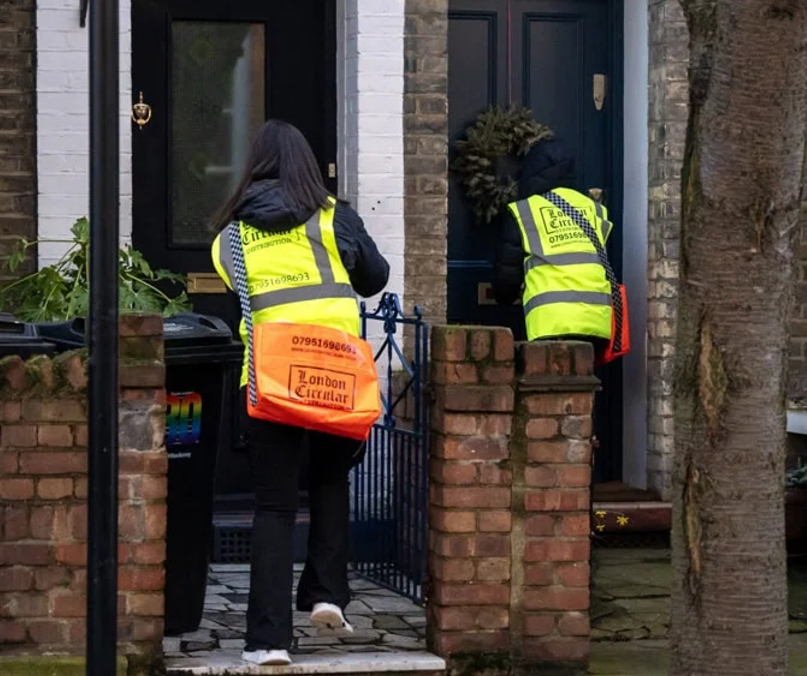
Shared rounds suit a first test on a modest budget, since the leaflet travels alongside other non-competing material and the cost per thousand falls sharply. A solus round gives a cleaner reading because nothing else lands with it. Selected street delivery sits between the two, letting you name the exact roads you want walked.
Reading the Response Before Scaling the Print Run
Owners tend to judge a drop after ten days and stop counting. That is early. Response to print arrives in two waves, one in the first fortnight and a smaller one weeks later when somebody digs the leaflet out of a drawer. Worth tracking for at least six weeks before deciding anything.
Things worth writing down after a test round:
- The postcode of every enquiry that comes in, taken at the point of the call
- A separate number or offer code printed on each test batch
- The date each enquiry lands, so the second wave gets counted
- The route report showing which streets were walked and when
- How many enquiries turned into paid work, not just how many rang
See also: HVAC SEO Services: Grow Your Heating and Cooling Business Online
When the Test Says Stop Rather Than Scale
Sometimes a pilot comes back flat, and the area is not the problem. The offer is. A leaflet asking a household to ring for a quote requires more effort than one offering a fixed price for a fixed job, and no amount of extra coverage can repair a weak offer. Changing the leaflet costs a printing bill. Changing thirty thousand of them costs rather more.
There is a version of this where the test misleads you, and it is worth admitting. One round through a street reaches households in the particular week their boiler failed. Everyone else glanced and forgot. A quiet test does not always mean a bad area, which is why some campaigns get a second pass before the verdict counts.
Starting Small Before the Print Bill Grows
Nobody remembers the leaflets that worked. They remember the thirty thousand that did not, and the invoice that arrived anyway. A pilot round with proper records behind it turns a guess into a decision, and the second campaign gets built on something firmer than optimism. Get in touch for a free quote and some straight advice on where a first test drop is likely to pay for itself.